The Two Classes of Spatial AI: Canvas and Camera
Spatial AI is dividing into imagined worlds and precise reality

Today's vision models are trained on flat 2D pixels. They struggle to understand depth, motion, and physics essential for mission-critical domains where fidelity and temporal accuracy are non-negotiable.
The answer is geometry.
ChronoSpace AI is building the first Geometry-Native Foundation Model (GFM), trained on real-world 4D data: how people, objects, and environments move and interact across time.
Our GFM enables us to reconstruct highly realistic, dynamic 4D scenes from sparse inputs with the fidelity required for mission-critical deployment.
This unlocks true spatial intelligence: AI that understands physics, maintains temporal consistency, and generalizes across domains.
Geometry-native data unlocks Spatial AI.
Mission-critical domains demand spatial intelligence
Robots train on 4D reconstructions of human workflows, using geometry-native content that captures affordances and motion patterns with physics built in. These reconstructions also serve as high-fidelity simulation environments, enabling validation before deployment and closing the sim-to-real gap.
Analysts transform drone footage into battlefield 4D reconstructions for situational awareness and threat analysis. CCTV becomes explorable geometry-native security environments, while immersive 4D scenes train personnel across missions, logistics, and equipment.
4D reconstructions create geometry-native digital twins of factory floors, warehouses, and construction sites. They enable optimization, safety checks, and automation that pixels or CAD can't deliver. High-fidelity scenes can be replayed to test layouts, validate automation, and improve safety before deployment.
Our team combines proven track records. Paul Walborsky built AI.Reverie, a pioneer in synthetic data for computer vision, acquired by Meta in 2021. Srinath Sridhar, co-founder and CEO, is Professor of Computer Science at Brown University and head of the Interactive 3D Vision Lab. Our breakthroughs in geometry-native AI have been published at CVPR, NeurIPS, and SIGGRAPH — and now we're turning research into reality.
Dive deeper into ChronoSpace AI
Spatial AI is dividing into imagined worlds and precise reality

Building the data layer robotics infrastructure needs

Building U.S. ecosystems to win the hard power AI race

Unlocking Spatial AI for mission-critical applications

How real-world 4D data unlocks Spatial AI
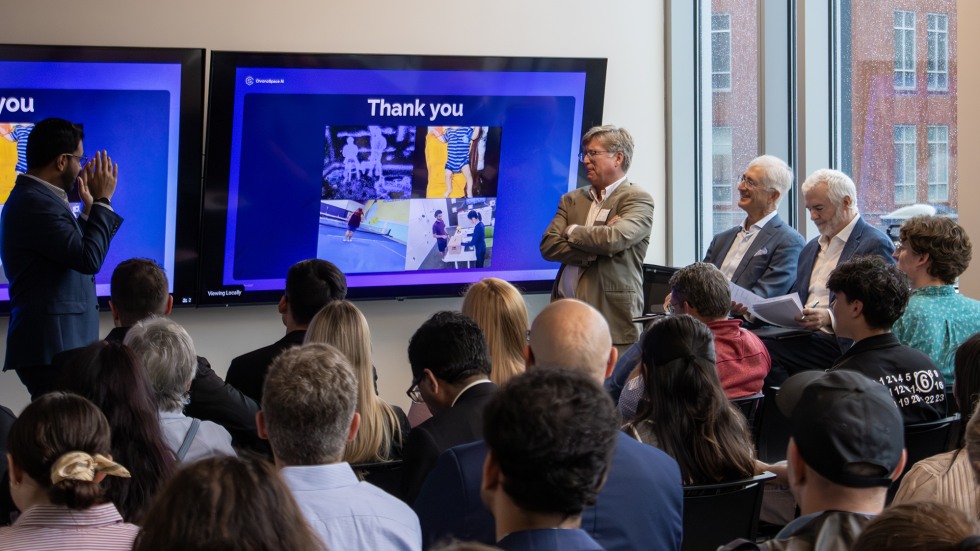
Featuring ChronoSpace AI at Brown's Innovation Showcase
ChronoSpace AI is building the infrastructure layer every industry will need. We're inviting collaborators across two fronts:
Industry leaders guiding and validating
mission-critical applications.
Engineers, researchers, and operators
building high-fidelity infrastructure.
Interested in shaping Spatial AI? Let's talk.